Advent Calendar Marketing: How to Run a 24-Day Offer Campaign on Your Online Store
Build an engaging 24-day holiday campaign with daily promotion ideas, practical WooCommerce setup tips, email marketing strategies, and gamified rewards designed to encourage repeat visits and customer engagement.
The holiday shopping season gives online retailers an opportunity to engage customers beyond traditional discounts and Black Friday promotions. Advent calendar marketing turns December into a series of daily experiences, encouraging shoppers to return to your store to discover new offers, rewards, and seasonal surprises.

Overview
This guide explains how to build a practical 24-day campaign, choose profitable incentives, promote daily offers, and use gamification to create a more engaging shopping experience.
What Is Advent Calendar Marketing,
and Why Does It Work?
Advent calendar marketing is a seasonal promotional strategy in which businesses reveal a new offer, reward, or experience each day leading up to Christmas. Inspired by traditional advent calendars, the digital version replaces physical gifts with incentives such as discount codes, exclusive products, free shipping, loyalty rewards, or interactive games.
The strength of advent calendar marketing lies in creating a reason for customers to return. Instead of displaying the same promotion for several weeks, retailers introduce something new each day, building anticipation and encouraging shoppers to explore different products. This approach combines several familiar marketing principles: curiosity, perceived exclusivity, limited-time availability, and rewarding customer participation.
However, a countdown alone does not guarantee more sales. The campaign needs relevant products, genuinely useful offers, clear participation rules, and a shopping experience that makes claiming rewards easy. Otherwise, customers may interact with the calendar without making purchases.
How an Online Advent Calendar Creates Engagement
A digital advent calendar typically features 24 numbered windows or daily promotional messages. Customers visit the campaign page, open the current day's window, and discover the available reward. Depending on the implementation, the experience might be a simple landing page, a visual calendar, or an interactive promotional game.
The daily reveal gives shoppers a reason to check back, particularly when future offers remain undisclosed. For example, a skincare retailer might feature a cleanser bundle one day, a complimentary travel-size product the next, and a limited-time gift set later in the month. These offers help customers discover products they might otherwise overlook.
Choose the Right Advent
Calendar Format for Your Store
Not every e-commerce business needs a complex interactive calendar. The right format depends on your available resources, product range, website functionality, and audience preferences. A small WooCommerce store can run an effective campaign using a dedicated promotion page and scheduled emails, while a larger retailer might invest in interactive calendar software.
Before selecting the format, consider how often customers typically purchase from your store. Businesses selling frequently replenished products may benefit from repeat-purchase incentives, while stores with longer buying cycles might focus on gift discovery, email subscriptions, and customer engagement.
Daily Deals and Discount-Based Calendars
The simplest format reveals one promotion each day. Offers might include percentage discounts on selected categories, free shipping above a minimum order value, product bundles, or complimentary gifts with qualifying purchases.
This approach is relatively straightforward to organize because the store controls the promotion schedule and can prepare offers in advance. However, discounting too heavily can reduce profit margins and teach customers to postpone purchases in anticipation of better deals. Mixing monetary discounts with added-value incentives helps avoid that problem.
Interactive Calendars and Gamified Rewards
Interactive formats require customers to participate before revealing their reward. Depending on the chosen software, this could involve opening a digital door, answering a question, completing a short challenge, or playing a game.
Gamification can make holiday campaigns more memorable by adding an element of participation and surprise. For instance, a visitor who is about to leave an online store could be invited to play a short game for a chance to receive a discount. The interaction creates an additional opportunity to engage the visitor rather than relying exclusively on static promotional banners.
The important distinction is that a dedicated advent calendar and a gamified promotional pop-up serve different purposes. A calendar manages the sequence of daily reveals, while a game-based pop-up can provide an additional reward or engagement opportunity during the campaign.
Plan Your Advent Calendar
Marketing Campaign Before December

Successful seasonal campaigns require preparation well before the first promotional window opens. Ideally, retailers should use November to finalize their offers, organize campaign assets, check inventory, and test the customer experience. Starting early also makes it easier to coordinate promotions with Black Friday activities and shipping deadlines.
Strong advent calendar marketing begins with a clear objective. Some stores prioritize immediate sales, while others want to introduce new products, increase email subscriptions, encourage repeat visits, or reactivate existing customers. These objectives affect which rewards make sense and how campaign performance should be measured.
Establish Goals and Promotion Limits
Before choosing daily deals, calculate how much promotional value your business can comfortably offer. Consider product margins, fulfillment expenses, payment fees, and any existing discounts that customers might combine with the campaign.
Set clear rules for minimum order values, eligible products, coupon stacking, and reward expiration. For example, offering free shipping above a qualifying basket value may be more sustainable than providing a storewide discount on a low-margin product category.
Prepare a Realistic Campaign Timeline
A useful preparation schedule looks like this:
-
November 1–15: Define campaign goals, choose products, assess margins, and plan rewards.
-
November 16–23: Create the calendar design, landing page, promotional copy, coupon codes, and email content.
-
November 24–30: Test the campaign on desktop and mobile, verify coupons, and announce the upcoming countdown.
-
December 1–24: Reveal daily offers, monitor results, check inventory, and adjust promotional messaging where necessary.
-
December 25 onward: Review campaign performance, analyze purchases and subscriptions, and prepare relevant customer follow-ups.
The daily promotion schedule should begin on December 1, rather than spending the first week simply announcing the campaign. Teaser activity belongs in the preparation period, allowing customers to participate from the first day.
24 Advent Calendar Promotion
Ideas for Online Stores
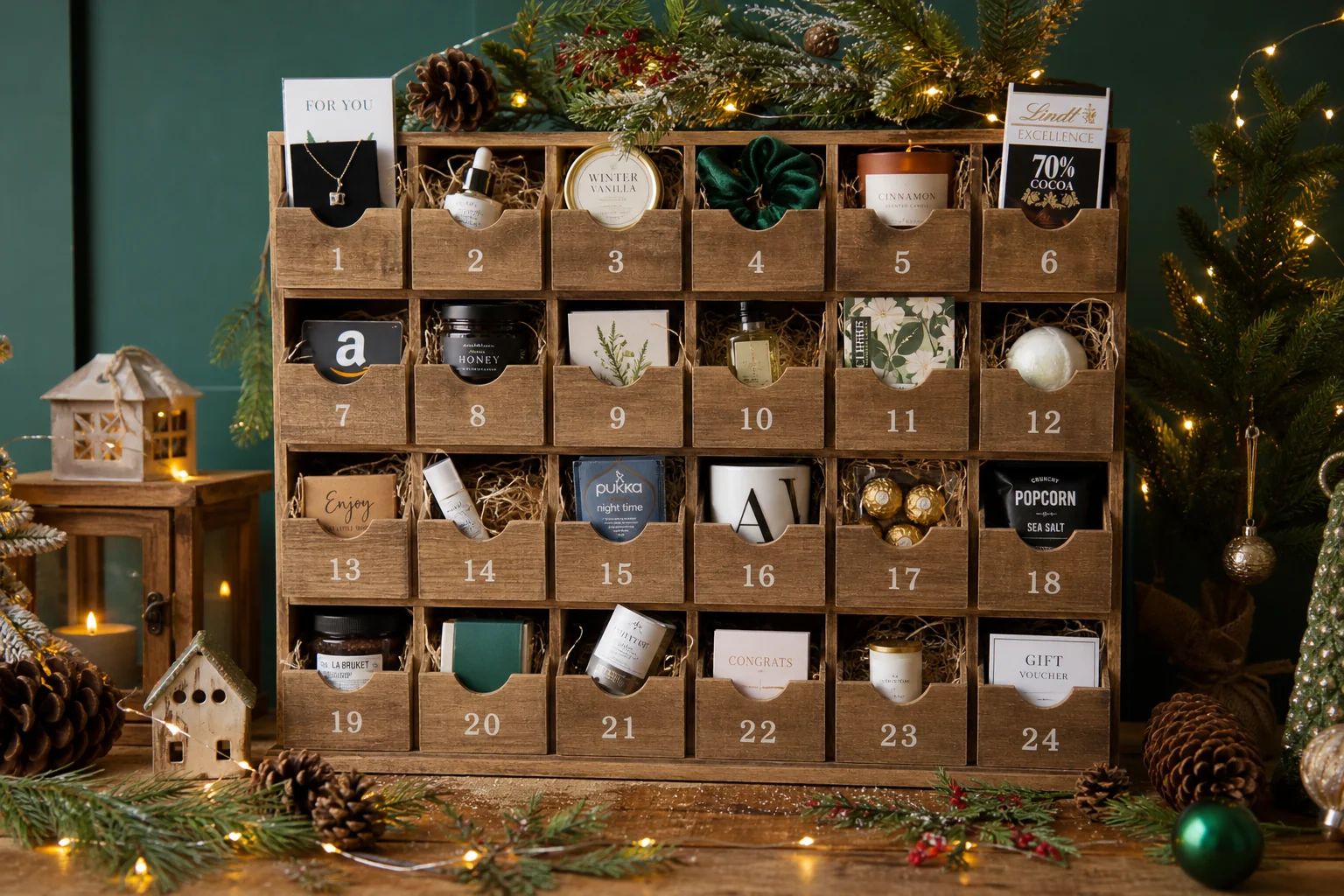
A successful calendar needs more than 24 versions of the same discount. Variety keeps the campaign interesting and gives different customer segments reasons to participate. While some shoppers respond to price incentives, others may value product discovery, exclusive access, free gifts, or convenient delivery options.
The following example illustrates how an e-commerce store could structure its December campaign. These are hypothetical promotional ideas, not measured campaign results. Adapt each offer to your products, operating capabilities, and profitability requirements.
| Day | Example Daily Offer | Primary Objective |
|---|---|---|
| December 1 | Holiday gift guide with curated products | Introduce the campaign |
| December 2 | Free shipping on qualifying orders | Encourage purchases |
| December 3 | Exclusive promotion on one product category | Drive product discovery |
| December 4 | Special seasonal product bundle | Increase basket value |
| December 5 | Surprise discount on eligible products | Encourage engagement |
| December 6 | Complimentary sample with qualifying orders | Introduce new products |
| December 7 | Exclusive offer for newsletter subscribers | Reward subscribers |
| December 8 | Gifts-under-budget collection | Help shoppers find gifts |
| December 9 | Limited-time product upgrade offer | Encourage higher-value purchases |
| December 10 | Product recommendation quiz with a reward | Improve engagement |
| December 11 | Discounted complementary accessory | Support cross-selling |
| December 12 | Free gift above a minimum basket value | Increase order value |
| December 13 | Bestselling products spotlight | Simplify purchase decisions |
| December 14 | Second-item discount on selected products | Encourage multi-item orders |
| December 15 | Seasonal product spotlight with limited availability | Highlight relevant stock |
| December 16 | Referral reward for eligible customers | Encourage referrals |
| December 17 | Gift card promotion | Reach undecided gift buyers |
| December 18 | Exclusive benefit for returning customers | Reward loyalty |
| December 19 | Mystery gift with clearly stated eligibility | Create anticipation |
| December 20 | Digital product or instant-delivery offer | Serve last-minute buyers |
| December 21 | Local pickup or delivery option spotlight | Highlight convenience |
| December 22 | Final shipping deadline reminder | Set delivery expectations |
| December 23 | Digital gift card or instant gift option | Capture last-minute demand |
| December 24 | Christmas Eve thank-you reward | Finish the campaign positively |
This schedule deliberately combines promotional and non-promotional activities. Not every day needs a discount, particularly when the campaign includes useful gift recommendations or exclusive shopping experiences.
For stores with smaller product catalogs, promotions can rotate between bestsellers, accessories, product bundles, and loyalty incentives. Retailers should also ensure that any advertised scarcity or delivery deadline reflects genuine availability and operational capacity.
How to Set Up an
Advent Calendar Campaign in WooCommerce
WooCommerce provides useful tools for managing discount codes, product pricing, and promotional eligibility, making it a practical foundation for a seasonal campaign. However, its standard coupon functionality does not automatically create an interactive 24-window advent calendar. A dedicated calendar interface requires an appropriate plugin, theme customization, or a separately built campaign page.
The simplest setup uses a holiday landing page that displays the current day's offer and directs customers toward the relevant product collection. More advanced implementations can use separate daily reveals, automated email campaigns, and interactive promotional elements. Whatever approach you choose, customers should always understand the offer and how to redeem it.
Create and Test Your Daily Coupons
In WooCommerce, navigate to Marketing → Coupons to create promotional codes. Depending on your campaign, you can configure percentage discounts, fixed-cart discounts, or fixed-product discounts.
WooCommerce also supports usage restrictions and limits, helping store owners define which products qualify and how often coupons can be redeemed. Its official coupon management documentation explains these settings and the available scheduling options.
Before launching, test the coupons with real shopping-cart scenarios. Check whether discounts work with sale items, how minimum spending thresholds are calculated, and what happens when customers attempt to use expired or ineligible codes.
For offers requiring precise hourly expiration, additional functionality may be necessary. WooCommerce's Smart Coupons documentation explains the difference between basic coupon expiration and more granular time-based controls.
Automate Daily Reveals Where Possible
Running 24 different offers manually increases the likelihood of publishing errors. Where supported by your tools, schedule the campaign page updates, coupon availability, and promotional emails before December begins.
Check that all connected systems use the intended time zone and that visitors cannot redeem upcoming offers prematurely. You should also prepare fallback messaging for products that sell out and confirm that landing pages remain functional when a promotion ends.
Even with automation, review the live experience each day. A successful email campaign can lose potential orders if its linked product is unavailable or the advertised coupon no longer works.
Promote Advent Calendar
Marketing Across Multiple Channels
A well-designed calendar needs consistent visibility to attract participants. Website visitors should be able to discover the promotion through a prominent but unobtrusive banner, navigation link, or dedicated seasonal landing page. Email and social media can then encourage customers to return for the next reveal.
In advent calendar marketing, consistency matters more than sending the highest possible number of messages. Customers should recognize the campaign immediately, understand what makes each day's offer relevant, and know when it expires. Use consistent holiday branding while allowing the featured products and rewards to change.
Email Marketing and Customer Segmentation
Email is especially useful because it allows businesses to reach customers who have already shown interest in their products. Rather than sending identical messages to every subscriber each day, segment your audience according to relevant preferences, purchase history, or previous engagement.
A returning customer might appreciate access to a loyalty reward, while a new subscriber could receive a curated selection of popular gift ideas. This makes the campaign more relevant without relying entirely on larger discounts.
Combining seasonal promotions with gamification in email marketing can also introduce interactive rewards and encourage participation. Keep email frequency manageable, explain what subscribers can expect, and respect their communication preferences.
For businesses serving European customers, email collection and promotional communications must also follow applicable privacy requirements. The European Commission's guidance on consent and data processing explains important principles, including valid consent and withdrawal rights. Review applicable ePrivacy and national marketing rules before launching a subscription campaign.
Social Media and Website Promotion
Social media works well for revealing daily offers, showcasing products, and building anticipation. Retailers can use Instagram Stories, short videos, product demonstrations, and countdown posts to remind followers that a new promotion is available.
On the website, link promotional banners directly to the active daily offer rather than sending visitors to a generic homepage. Consider showing upcoming calendar windows without revealing their contents, giving shoppers a reason to return.
Keep the promotion accessible on mobile devices. Avoid covering important content or interrupting the checkout process with aggressive promotional overlays. Google's guidance on intrusive interstitials explains how disruptive dialogs can affect content accessibility and search performance.
Add Gamification Without
Disrupting the Shopping Experience
A holiday campaign can attract considerable attention, but not every visitor will immediately complete a purchase. Some will browse products, compare prices, or leave the store after exploring an offer. This creates an opportunity for a carefully timed engagement strategy.
Rather than displaying additional discounts to every visitor, retailers can use interactive incentives at relevant moments. For example, a shopper showing an intention to leave might be offered a chance to play a quick game and receive a discount. This adds a different kind of interaction to the holiday experience without requiring another full-scale promotional campaign.
Funnelsio provides gamified exit-intent pop-ups for e-commerce stores, including WooCommerce integration. Its reward-based approach allows visitors to play a game for a chance to receive a discount coupon, with functionality designed to support lead generation and purchase incentives.
During a December campaign, this type of tool could complement the daily advent offers by engaging visitors who are about to leave. It does not replace a dedicated advent calendar or automatically manage 24 daily reveals. Store owners should also check that any additional reward works with their existing coupon restrictions and does not unintentionally reduce margins.
A well-timed incentive is most useful when it addresses an actual purchase obstacle. If visitors are abandoning their carts because shipping costs are unexpectedly high, for instance, improving the checkout experience may be more valuable than introducing yet another discount.
Measure Your Advent
Calendar Campaign Results
Daily promotional activity should be evaluated against clear business outcomes rather than engagement alone. A large number of calendar opens may indicate curiosity, but those interactions do not necessarily translate into profitable orders.
Track results throughout December and compare them with appropriate baselines, while accounting for changes in advertising spend, product availability, and seasonal shopping demand. When possible, use a controlled experiment to assess whether a specific feature or incentive causes an improvement rather than simply appearing alongside one.
Key Performance Indicators to Monitor
Useful metrics include:
-
Calendar engagement rate: The percentage of eligible visitors who interact with the campaign.
-
Repeat visitor rate: The proportion of visitors who return during the promotional period.
-
Email subscription rate: The percentage of visitors who subscribe to marketing communications.
-
Coupon redemption rate: The percentage of issued or claimed coupons that are redeemed.
-
Purchase conversion rate: The percentage of campaign visitors who complete an order.
-
Average order value: The average revenue generated per completed order.
-
Revenue per visitor: Revenue divided by the number of visitors in the measured audience.
-
Promotional profitability: Revenue remaining after relevant discounts, product costs, and variable expenses.
These metrics reveal different aspects of campaign performance. For instance, high coupon redemption combined with declining profit margins may suggest that the campaign is attracting purchases at an unsustainable cost.
Evaluate both immediate purchases and subsequent customer behavior. Subscribers acquired during December may create value through future orders, but that value should be measured rather than assumed.
Common Advent Calendar
Marketing Mistakes to Avoid
One common mistake is offering discounts that become progressively larger throughout December. Customers may notice the pattern and delay purchases, reducing the effectiveness of earlier promotions. A better approach is to vary rewards according to customer needs rather than following a predictable discount escalation.
Another challenge is managing inventory and fulfillment. Promoting a popular item without sufficient stock can create frustration, while advertising delivery promises that cannot be met may damage customer trust. Coordinate closely with your fulfillment team and ensure that daily campaigns reflect current product availability.
Promotion fatigue is equally important. Daily emails, repeated pop-ups, and constant social reminders can overwhelm customers if every interaction demands immediate action. Give visitors control over their participation, keep messages useful, and avoid repeatedly interrupting shoppers who have already engaged with the promotion.
Finally, pay attention to technical reliability. Test coupon validity, mobile layouts, campaign links, and offer expiration rules before launch. A 24-day campaign provides multiple opportunities to improve performance, but it also creates more opportunities for small technical errors to affect the customer experience.
Conclusion: Turn Your Holiday Countdown
Into a Better Shopping Experience
Successful advent calendar marketing is about more than offering 24 discounts. It creates a structured series of customer experiences that combine anticipation, product discovery, and well-timed incentives throughout the holiday season.
The strongest campaigns begin with a clear plan, protect profit margins, and make participation simple. By combining daily promotions with relevant email communication, reliable WooCommerce functionality, and selective gamification, retailers can create additional opportunities to engage shoppers without overwhelming them.
If you want to make your holiday promotions more interactive, explore how Funnelsio's gamification solution can complement your campaign with exit-intent rewards and lead-capture opportunities.
Questions
Answered
Common questions related to this topic.
What is advent calendar marketing?
Advent calendar marketing is a promotional strategy that offers daily deals or special offers leading up to Christmas. It creates excitement and anticipation among customers, encouraging them to return to your online store each day. This approach can be tailored for both physical and digital products.
How does advent calendar marketing work?
Advent calendar marketing works by presenting a new deal or product each day of December, typically until Christmas. You can use email marketing and social media to promote these offers, ensuring customers know about the daily deals. This strategy can significantly boost customer engagement and sales.
Why should I use an online advent calendar for my store?
Using an online advent calendar can enhance user experience by creating a fun and interactive way for customers to discover new products or discounts. It encourages repeat visits and increases the chances of impulse purchases. Additionally, it helps build brand loyalty during the holiday season.
Can small businesses benefit from advent calendar promotions?
Absolutely! Small businesses can effectively use advent calendar promotions by offering carefully curated deals that resonate with their audience. Tailoring offers based on customer preferences can create excitement and drive engagement, proving that even smaller brands can thrive with this marketing tactic.
What are some best practices for implementing advent calendar marketing?
To implement advent calendar marketing successfully, start by planning your daily offers well in advance. Make sure to promote them through various channels like email and social media. Personalization can also enhance the effectiveness of your campaign, making customers feel special and valued.
When is the best time to launch an advent calendar campaign?
The best time to launch an advent calendar campaign is at the beginning of December, ideally on the 1st. This timing allows customers to engage with your offers throughout the entire month leading up to Christmas, maximizing visibility and potential sales during the holiday season.
Ready To GrowThis Into Results?
Build an engaging 24-day holiday campaign with daily promotion ideas, practical WooCommerce setup tips, email marketing strategies, and gamified rewards designed to encourage repeat visits and customer engagement.
Prefer to reach out directly? We'll get back to you as soon as possible.
Contact MASS DATA Today