Christmas Shipping Deadline: How to Tell Shoppers the Last Day They Can Order
Discover how to calculate realistic Christmas shipping deadlines for your online store. Learn the difference between carrier and customer cutoffs, create clear shipping banners, configure WooCommerce delivery options, and manage last-minute holiday orders.
The final weeks before Christmas are a critical period for online retailers. Shoppers are searching for last-minute gifts, comparing delivery options, and deciding whether their orders will arrive in time for the celebrations. Communicating the christmas shipping deadline clearly can help customers make informed purchasing decisions while reducing uncertainty about holiday delivery.

Overview
This guide explains how to determine realistic last-order dates, communicate them through shipping cutoff banners and other website messages, configure WooCommerce shipping options, and keep customers engaged even after standard Christmas delivery becomes unlikely.
What Is the
Christmas Shipping Deadline?
A Christmas shipping deadline is the latest date and time associated with getting an order delivered before Christmas. For an online retailer, this usually means the final time customers can place an eligible order with a reasonable expectation that it will arrive by the advertised holiday delivery date.
However, retailers need to distinguish between a carrier's last recommended shipping date and the store's last order date. These are not necessarily the same. A parcel carrier might recommend handing over packages by December 18, but a store requiring two business days to prepare an order must stop accepting qualifying Christmas-delivery orders earlier.
Customers generally care about one thing: whether the products will reach them when needed. A retailer's responsibility is to translate complicated fulfillment schedules into clear, accurate delivery information.
Last Order Date vs. Last Shipping Date
The last shipping date is the latest date on which a package should be handed over to the delivery provider to meet the intended delivery window. This date depends on the carrier, shipping service, destination, and seasonal operating schedule.
The last order date for Christmas is the deadline established by the online store. It must account for everything that happens between checkout and carrier handover, including payment processing, picking, packing, warehouse operating hours, and any additional preparation.
Confusing these two deadlines can result in a store accepting orders that cannot realistically be dispatched in time. Merchants should therefore calculate their own cutoff rather than simply repeating the date published by a courier.
How to Calculate the Christmas
Shipping Deadline for Your Store
A reliable Christmas shipping deadline starts with understanding your actual fulfillment process. Begin with the latest carrier handover date that reasonably supports delivery by Christmas, then work backward through the time required to prepare and dispatch an order.
For many destinations, December 24 is a more appropriate target delivery date than December 25, when some major carriers suspend ordinary operations. However, this depends on the destination country and the carrier's holiday schedule. Local delivery services and regional carriers may operate differently.
Retailers should also include a reasonable contingency buffer. Peak-season order volumes, limited warehouse capacity, and unexpected disruptions can make normal processing estimates less reliable.
Five Factors That Determine the Final Order Date
Before publishing a deadline, evaluate the following:
-
Carrier service and destination: Standard, express, domestic, and international delivery services have different transit times and holiday schedules.
-
Order processing time: Include payment verification, picking, packing, and any required product preparation.
-
Inventory availability: Products shipped from suppliers, external warehouses, or different fulfillment locations may require additional time.
-
Weekends and public holidays: Consider warehouse opening days, courier collection schedules, and holidays in both the origin and destination countries.
-
Safety buffer: Allow additional time for foreseeable operational delays, particularly where delivery before Christmas is essential.
These factors may produce several deadlines for the same online store. Domestic orders using express delivery might remain eligible longer than international orders using standard shipping.
Rather than communicating one universal date, consider grouping destinations and shipping methods into clear categories. This reduces the risk of presenting misleading information to customers whose deliveries require additional time.
A Practical Last-Order-Date Calculation
Imagine a hypothetical retailer whose delivery partner recommends handing over eligible parcels no later than Friday, December 18, 2026. The store normally needs two business days to process orders and wants to allow one additional business day for unexpected delays.
Working backward, the retailer could set its final order cutoff for Tuesday, December 15, at noon in the store's operating time zone. This allows the warehouse to prepare orders during the following business days while preserving a contingency before the carrier's deadline.
This example illustrates the calculation rather than establishing an actual delivery guarantee. The final date must be checked against the relevant carrier service, destination, collection schedule, and the retailer's real fulfillment capacity.
Understanding Carrier Deadlines
for Christmas 2026

Shipping companies publish seasonal schedules to help businesses plan their fulfillment operations. These schedules typically distinguish between domestic and international destinations, as well as economy, standard, and expedited shipping services.
Each year, USPS publishes recommended send-by dates for its Ground Advantage and Priority Mail services within the contiguous United States. These are recommended carrier shipping dates, not universal last-order dates for online stores and not unconditional delivery guarantees. These are recommended carrier shipping dates, not universal last-order dates for online stores and not unconditional delivery guarantees.
Retailers can review the latest information directly from USPS holiday shipping dates, the UPS holiday shipping schedule, and FedEx holiday shipping guidance.
The appropriate dates differ by location and service. Merchants shipping from Europe, the United Kingdom, or other markets should consult their own carriers and regional holiday schedules instead of applying US deadlines.
Why Recommended Carrier Dates Are Not Guarantees
A recommended shipping date indicates when a carrier advises sending a parcel under specified conditions. It doesn't necessarily guarantee arrival by Christmas, particularly when unexpected weather, service disruptions, incorrect addresses, or customs delays affect delivery.
Retailers should distinguish carefully between an estimated arrival date and a legally binding delivery commitment. A message stating that an order is expected before Christmas carries a different meaning from an unconditional promise of guaranteed Christmas delivery.
For merchants serving EU consumers, the European Commission's consumer rights guidance explains that agreed delivery times matter and that customers may have remedies when goods do not arrive as agreed. Businesses should review applicable consumer protection requirements before making delivery commitments.
How to Communicate the
Christmas Shipping Deadline Clearly
A visible Christmas shipping deadline helps shoppers decide when to order and which delivery method to choose. However, placing the information on a single shipping policy page is rarely sufficient during the busiest holiday shopping weeks.
Customers enter online stores through different channels, including product pages, search results, advertisements, and email campaigns. They may never visit the homepage before reaching checkout. Delivery information should therefore appear wherever it materially affects a purchase decision.
The goal is consistency. A homepage banner, product-page notice, cart message, and checkout estimate should not contradict one another. If the cutoff differs by destination or shipping service, the message needs to reflect those conditions.
Homepage Shipping Cutoff Banners
A shipping cutoff banner is a compact announcement positioned prominently within the website, often near the top of the page. It can communicate the last ordering date without forcing visitors to interrupt their shopping.
For example, a retailer could display:
"Order by December 15 for Expected Christmas Delivery on Eligible Orders."
This is illustrative copy only. The actual banner should specify relevant shipping conditions, the order cutoff time, and the destination restrictions when these details cannot be communicated clearly elsewhere.
The banner should also link to a dedicated holiday delivery information page. Customers who need more detail can then review applicable shipping methods, destination-specific deadlines, and any exclusions.
Avoid cluttering the announcement with multiple unrelated promotions. A clear delivery message is more useful than a banner that simultaneously advertises discounts, free gifts, loyalty rewards, and shipping deadlines.
Product Page Delivery Messages
Product pages are especially important because customers often evaluate delivery timing before adding an item to the cart. A small, relevant message near the purchasing controls can help them understand whether the product is likely to arrive before Christmas.
For example, an in-stock product could display an expected delivery window based on the selected destination and shipping method. Products requiring additional preparation should show a different estimate rather than inheriting a universal storewide cutoff.
Where dynamic delivery estimates are available, they should use the same underlying shipping data as checkout. If a customer changes their destination or delivery option, the displayed information should update accordingly.
Cart and Checkout Reminders
The cart and checkout are the final opportunities to communicate delivery conditions before an order is placed. At this stage, information should be specific to the customer's selected items, destination, and available shipping methods.
A concise message could explain that standard shipping is no longer expected to arrive before Christmas while eligible express services remain available. If no suitable physical delivery option exists, the store should communicate that limitation clearly.
Transparent delivery information is part of a seamless WooCommerce checkout experience. Unexpected costs, confusing conditions, and uncertain delivery dates can introduce unnecessary hesitation at an important stage of the purchase.
Write Holiday Shipping
Messages That Customers Understand

Effective holiday shipping messages communicate the deadline, eligible delivery conditions, and what customers should do next. They should be concise enough to read quickly without omitting information that changes the meaning of the offer.
Urgency can be appropriate when a genuine deadline is approaching. However, businesses should avoid language suggesting guaranteed delivery unless that promise is supported by their operations and the applicable shipping terms.
The following examples illustrate messages that could be adapted to verified store-specific deadlines.
Before the Final Ordering Date
"Order by December 15 at 12 PM for Expected Delivery by Christmas Eve."
A supporting message could explain that the offer applies to eligible in-stock products shipped to specified destinations using the relevant service.
This approach identifies an exact cutoff while making it possible to communicate important restrictions. Customers should not have to guess which shipping methods qualify.
When the Deadline Is Approaching
"Final Day to Order for Expected Christmas Delivery."
A short reminder can be useful when the verified cutoff is approaching. If a countdown timer is used, it must reference the correct deadline and time zone rather than an automatically resetting promotional timer.
Avoid extending or restarting the displayed deadline simply to encourage purchases. When the deadline changes for operational reasons, update the message transparently.
After Standard Shipping Is No Longer Suitable
"Standard Shipping May Arrive After Christmas. Check Available Express Options."
This message acknowledges the limitation while directing shoppers toward alternatives that may still meet their needs.
If the retailer cannot confidently offer any physical delivery service before Christmas, the website should stop implying that one remains available. Digital gift cards, downloadable products, or eligible local pickup options may provide more practical alternatives.
Where to Display Christmas
Shipping Messages Beyond Your Website
Not all customers will see a website announcement before deciding whether to purchase. Some may encounter a holiday promotion through email, social media, search advertisements, or product listings.
Coordinating these messages reduces the risk of attracting last-minute orders based on outdated delivery claims. When the store changes its cutoff, the information should also be reviewed across active advertising campaigns and scheduled communications.
Email Marketing and Subscriber Communication
Email campaigns can help remind existing customers about upcoming deadlines. A useful message might highlight relevant gift collections, explain the remaining delivery options, and link directly to the store's shipping information.
Rather than repeatedly sending urgent reminders to every subscriber, consider targeting customers whose interests or previous purchases make the offer relevant. For example, a customer browsing physical gift sets may need different information from someone interested in digital gift cards.
The email should focus on helping customers make a decision. It should not promise that an order will arrive by Christmas when the store cannot reasonably support that expectation.
Social Media and Paid Advertising
Seasonal advertisements often promote gifts, discounts, and last-minute shopping opportunities. If the advertised products require physical delivery, the campaign should remain consistent with current shipping conditions.
As the deadline approaches, retailers can shift creative messaging toward express delivery, local pickup, or digital products where those services are genuinely available.
Campaigns promoting Christmas delivery should be reviewed as soon as the cutoff passes. Continuing to advertise outdated deadlines can create confusion and attract orders the business cannot fulfill as expected.
Set Up Christmas
Shipping Information in WooCommerce
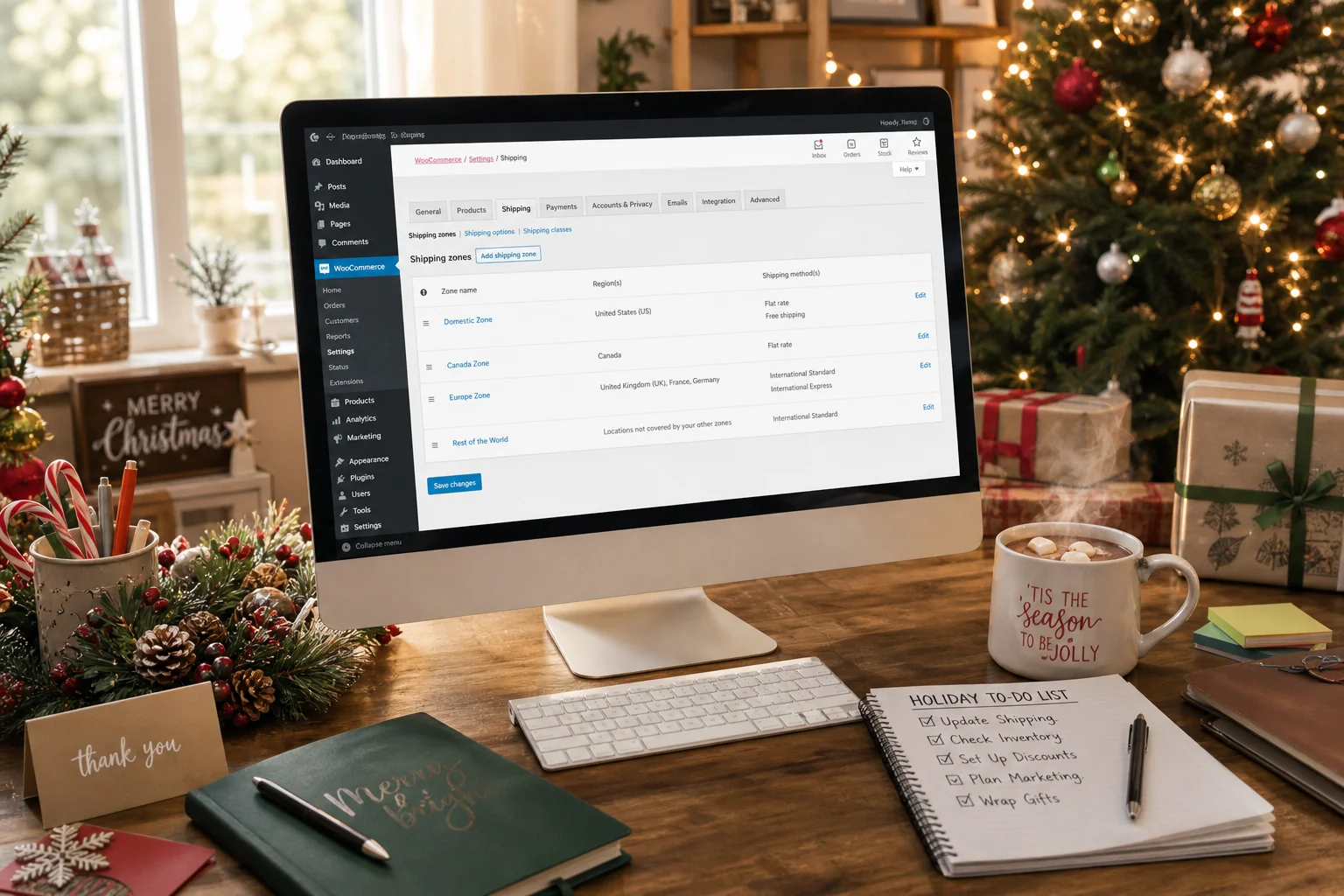
WooCommerce includes shipping configuration tools that help store owners offer different delivery methods according to customer location. However, its core shipping settings do not automatically calculate every retailer-specific Christmas ordering cutoff or generate a complete seasonal banner system.
Stores requiring advanced delivery estimates, order cutoffs, or automatic shipping restrictions may need a suitable extension or custom implementation. The appropriate solution depends on the warehouse setup, shipping services, and the complexity of the fulfillment rules.
Before introducing additional software, review the existing shipping configuration to ensure that customers see accurate options at checkout.
Configure Shipping Zones and Methods
In WooCommerce, navigate to WooCommerce → Settings → Shipping → Shipping zones to review the delivery regions and available methods.
Shipping zones determine which shipping options customers can access based on their delivery address. WooCommerce includes core methods such as Flat Rate, Free Shipping, and Local Pickup.
The official WooCommerce shipping zone documentation explains how these settings work and how zones are matched to customer destinations.
For Christmas delivery, consider whether different destinations require different information or available services. A domestic customer might qualify for a late standard-shipping cutoff, while an international customer may need to order substantially earlier.
Configure Express Delivery and Local Pickup
If the store offers express shipping, confirm that the service is available to the intended destinations and can be fulfilled within the required time. Faster courier transport doesn't help if the warehouse cannot dispatch the order before the relevant collection deadline.
Local pickup may provide another option after ordinary shipping deadlines have passed. However, the store needs a reliable process for preparing orders, notifying customers, and confirming collection availability.
WooCommerce supports local pickup as a shipping method, but the exact scheduling and availability functionality depends on the checkout setup and any additional extensions.
Do not display local pickup as an available solution unless the store can actually prepare the order and make it accessible before the customer's required date.
Test Deadline Messages Before Launch
A seasonal shipping announcement should be tested across the complete purchase journey. Check desktop and mobile layouts, product variations, destination changes, cart calculations, and checkout.
Pay particular attention to orders containing multiple products with different fulfillment requirements. A single made-to-order item could affect the dispatch timing of an entire order.
Also confirm how the website behaves when the deadline expires. If the banner remains visible after the cutoff, customers may interpret it as a continuing delivery promise.
What Happens After the
Christmas Shipping Deadline Passes?
Once the Christmas shipping deadline passes, retailers should adjust their promotional messaging rather than continue encouraging orders under outdated expectations.
This transition doesn't mean the holiday shopping opportunity is necessarily over. Some customers may still be interested in digital products, store collection, express delivery to eligible destinations, or purchases that are not required before Christmas.
The most important consideration is clarity. Customers should understand which options remain available and when they can reasonably expect their orders to arrive.
Promote Relevant Last-Minute Alternatives
Digital gift cards can be useful for shoppers who need a present without physical shipping, provided the store can issue and deliver them within the advertised timeframe. Other digital products may offer similar convenience.
Where operationally supported, local pickup or same-day delivery can serve nearby customers. Retailers should clearly state applicable locations, ordering deadlines, preparation times, and collection hours.
Stores may also continue selling physical products with transparent post-Christmas delivery estimates. Customers can make their own decisions when they have accurate information about when the items are expected to arrive.
Update Promos and Customer Communication
After a delivery cutoff, review active email sequences, advertising messages, website banners, and promotional landing pages. Replace expired promises with appropriate information about available shipping services.
If an order is unexpectedly delayed, notify the customer proactively and provide realistic next steps. Avoid waiting for shoppers to contact support when the business already knows that a communicated delivery date is at risk.
Clear service communication can preserve customer confidence even when circumstances change. Overpromising delivery and addressing the problem only after Christmas creates a much more difficult customer experience.
Use Exit-Intent Offers
Without Creating Delivery Confusion

Delivery uncertainty can be one reason customers abandon their carts. A shopper who discovers that an item may not arrive in time might leave to search for another retailer or consider a different type of gift.
An exit-intent offer can create another opportunity to engage this visitor, but the incentive should address a relevant concern. A discount does not solve an unavailable delivery service, and presenting one as though it does may lead to further disappointment.
A better strategy is to separate delivery information from promotional incentives. Make delivery conditions transparent first, then consider whether an additional reward or product recommendation would genuinely help the visitor.
How Funnelsio Can Complement Holiday Promotions
Funnelsio provides gamified exit-intent popups for e-commerce stores, including WooCommerce integration. Instead of displaying a conventional discount message, its game-based experience invites departing visitors to participate for a chance to receive a promotional coupon.
This can complement a holiday conversion strategy by introducing an interactive incentive to eligible visitors who appear ready to leave. However, Funnelsio is not a shipping deadline management platform, and its exit-intent functionality should not be presented as an automated system for calculating courier cutoffs or promising Christmas delivery.
For example, a retailer could use a game-based reward as part of a broader holiday campaign while separately maintaining accurate delivery notices throughout the store. The reward's coupon eligibility and expiration conditions should be coordinated with the promotion and tested through checkout.
A well-designed experience supports the purchase decision without concealing practical delivery limitations. The aim is to make the shopping journey more useful, not simply to prevent visitors from leaving.
Measure Whether Shipping
Deadline Messages Help Customers
Shipping information should be evaluated primarily through accuracy and customer experience, not only through immediate sales. A campaign that increases orders but creates widespread late-delivery complaints is unlikely to represent a successful outcome.
Clear communication may also influence conversion behavior by reducing uncertainty. However, an increase in purchases after adding a banner doesn't automatically prove that the message caused the improvement. Seasonal demand, advertising activity, product availability, and competing promotions can all affect results.
Useful performance indicators include checkout conversion rate, delivery-related support inquiries, on-time delivery rate, shipping method selection, and the proportion of orders requiring delay notifications.
Track Delivery Reliability
One practical measure is the percentage of qualifying orders delivered by their communicated date.
On-Time Delivery Rate = (Orders Delivered by the Agreed Date ÷ Eligible Delivered Orders) × 100
For example, imagine a hypothetical store with 500 eligible Christmas orders. If 480 arrive by the agreed delivery date, its on-time delivery rate for that group is 96%.
The calculation helps identify whether fulfillment commitments are realistic. It should be accompanied by separate analysis of delays caused by warehouse processing, carrier transit, incorrect addresses, or other operational factors.
Test Banner Clarity and Placement
Retailers can also test different ways of presenting shipping information. For example, one version might use a short announcement bar linking to a holiday delivery page, while another presents a compact delivery estimate directly on the product page.
The main question is whether customers understand the conditions more easily and make better-informed purchasing decisions. Review checkout performance, customer support questions, and feedback rather than focusing only on banner clicks.
Any experiment should preserve accurate delivery information in both variations. Testing should never involve deliberately showing a misleading deadline to part of the audience.
Common Christmas Shipping
Deadline Mistakes to Avoid

A frequent mistake is using the same cutoff for every destination. International orders, remote delivery areas, and expedited services often require different schedules. A universal deadline can create inaccurate expectations even when the information is correct for the store's primary market.
Another problem is confusing courier shipping dates with customer ordering dates. Businesses need to include their own fulfillment time and an appropriate contingency before promising a Christmas arrival window.
Retailers should also avoid unsupported guarantees. Messages such as "Guaranteed Before Christmas" can create commitments that the business may not be able to meet. Where delivery is estimated rather than guaranteed, the distinction should be clear and not contradicted elsewhere on the website.
Finally, shipping messages need ongoing maintenance. Deadlines can change because of operational disruptions, increased order volumes, or carrier announcements. A banner published in November should not be left unchanged through the final shopping days without checking whether it remains accurate.
Conclusion: Make Holiday
Delivery Expectations Clear
A reliable Christmas shipping deadline is an essential part of a well-organized holiday sales strategy. It helps shoppers decide when to order, reduces uncertainty about delivery, and gives retailers a clearer framework for managing seasonal fulfillment.
Start by reviewing carrier schedules and warehouse processing capacity, then calculate realistic customer ordering cutoffs. Communicate those dates consistently through website banners, product pages, checkout, email campaigns, and advertising. When the deadline passes, update the messaging and offer suitable alternatives rather than continuing to promote unavailable delivery options.
Once shoppers have clear delivery information, relevant incentives can help improve engagement. Explore Funnelsio's gamified exit-intent solution to see how interactive coupon rewards could complement your holiday promotions without replacing transparent shipping communication.
Questions
Answered
Common questions related to this topic.
What is the christmas shipping deadline?
The christmas shipping deadline refers to the last date that customers can place orders to ensure their packages arrive by Christmas. These deadlines vary by retailer and shipping method, making it crucial for businesses to communicate them clearly to customers.
How can I find the last order date for Christmas?
To find the last order date for Christmas, check the retailer's website or customer service section. Many e-commerce sites prominently display this information, especially during the holiday season, often through shipping cutoff banners.
Why is it important to communicate the christmas shipping deadline?
Clearly communicating the christmas shipping deadline helps set customer expectations and reduces the likelihood of order delays. This transparency encourages timely purchases and improves customer satisfaction, particularly during the busy holiday shopping period.
When should I start promoting the holiday shipping message?
It's best to start promoting your holiday shipping message early in the holiday season. Begin displaying information about shipping deadlines at least a few weeks before Christmas to give customers ample time to make their purchases.
Can smaller businesses benefit from a shipping cutoff banner?
Yes, smaller businesses can greatly benefit from using a shipping cutoff banner. It helps inform shoppers about important shipping timelines, fostering trust and encouraging purchases, which can be especially vital during the competitive holiday season.
How do shipping carriers affect the christmas shipping deadline?
Shipping carriers have different deadlines based on their service levels (e.g., standard vs. expedited). Therefore, it’s essential for retailers to check with their chosen carriers to determine the accurate last order dates for timely delivery before Christmas.
Ready To GrowThis Into Results?
Discover how to calculate realistic Christmas shipping deadlines for your online store. Learn the difference between carrier and customer cutoffs, create clear shipping banners, configure WooCommerce delivery options, and manage last-minute holiday orders.
Prefer to reach out directly? We'll get back to you as soon as possible.
Contact MASS DATA Today