January Sales Ideas for Online Stores: Clear Winter Stock and Keep New Subscribers
Discover practical January sales strategies for online stores, from winter clearance offers and product bundles to targeted emails and gamified exit-intent rewards. Learn how to sell seasonal inventory, retain holiday subscribers, and measure campaign profitability.
The holiday shopping rush may be over, but January presents a valuable opportunity for e-commerce businesses. After weeks of Christmas promotions, retailers often face a familiar challenge: excess seasonal inventory, slower shopping activity, and new subscribers who haven't yet developed a lasting relationship with the brand. The right january sales ideas can help address all three without relying on increasingly aggressive discounts.

Overview
This guide explores practical winter sale strategies, creative promotions, WooCommerce implementation tips, and ways to use gamification and email marketing to maintain customer engagement after Christmas.
Why January Sales
Need a Different Strategy
December marketing typically revolves around gift shopping, holiday delivery deadlines, and limited-time promotions. January brings different purchasing motivations. Some customers are looking for discounted winter essentials, others are exploring products related to New Year's goals, and many are simply more selective about spending after the holidays.
For online retailers, this creates two distinct opportunities. The first is operational: selling excess seasonal inventory before demand decreases further. The second is relationship-focused: reconnecting with customers and subscribers acquired during Black Friday and Christmas campaigns. Both objectives matter, but they require different promotional messages.
A successful New Year sale should therefore begin with an understanding of inventory, customer behavior, and product profitability. Discounting every product equally might generate orders, but it can also reduce margins on items that would have sold at their regular prices.
Identify Which Products Actually Need Clearance
Before launching a winter sale, review current stock levels, sales velocity, product margins, and seasonal demand. Products with substantial remaining inventory and declining demand may justify stronger promotional incentives than evergreen bestsellers.
For example, a fashion retailer might prioritize seasonal colors, discontinued winter styles, or overstocked sizes while keeping popular year-round accessories at their normal prices. A homeware store could focus on remaining holiday decorations, winter textiles, and seasonal gift sets.
Not every slow-selling product needs a large discount. Some items may perform better when grouped into bundles, promoted to a more relevant audience, or given greater visibility within the store.
9 January Sales Ideas to
Clear Stock and Engage Customers
The most effective promotions combine commercial objectives with a clear customer benefit. Instead of simply announcing another storewide discount, consider how different offers can solve shopping problems, introduce overlooked products, or make the remaining winter inventory more appealing.
These January sales ideas can be adapted to different e-commerce categories, including fashion, beauty, homeware, fitness, electronics, and specialty retail. The examples below are hypothetical and should be evaluated against your own product margins, available stock, and customer demand.
1. Run a Targeted Winter Clearance Sale
A winter clearance campaign is a straightforward way to move products that may become harder to sell as the season progresses. Rather than discounting the entire store, create a dedicated collection featuring selected seasonal products, discontinued lines, or excess inventory.
For example, an outdoor clothing store could run a "Winter Essentials Clearance" featuring jackets, gloves, and thermal accessories. Organizing discounted products into a clear collection helps shoppers understand the offer and find relevant items without searching through unrelated categories.
Use genuine price reductions and communicate the conditions accurately. For stores selling to EU consumers, applicable price-reduction rules generally require reference to the lowest price charged during the preceding 30 days, subject to relevant exceptions. The European Commission's guidance on price reductions provides further information.
2. Create Bundles From Complementary Products
Bundles can help retailers move slower-selling inventory while offering customers practical value. Instead of promoting individual products separately, combine complementary items into a package that makes sense for a particular use or occasion.
A beauty store might create a winter skincare bundle containing a moisturizer, cleanser, and lip balm. A homeware retailer could combine blankets, candles, and decorative cushions into a seasonal comfort collection. The bundle should simplify purchasing rather than merely group unrelated products.
Calculate the profitability of the combined offer before launching it. A bundle that increases average order value may still be unattractive if its discount reduces the contribution margin too much.
3. Launch a Short, Clearly Defined Flash Sale
A flash sale concentrates attention on a particular collection or product group for a limited period. For example, a retailer could offer a 48-hour promotion on selected winter accessories rather than advertising one continuous discount throughout January.
The limited duration creates a clear reason to consider the offer now. However, urgency should be based on genuine deadlines, and the promotion must end when advertised. Repeatedly resetting countdown timers or suggesting artificial scarcity can undermine trust.
Flash sales are especially useful when supported by targeted emails and website messaging. Avoid running them too frequently, since customers may begin waiting for the next promotion instead of purchasing at regular prices.
4. Introduce Tiered Discounts or Spending Incentives
Tiered promotions encourage customers to purchase more qualifying products by offering a clearly defined benefit at different spending levels. An illustrative campaign might offer 10% off selected clearance products above €60 and 15% above €100.
These promotions can help move multiple items, but higher basket values do not automatically mean higher profits. Calculate the effect of each discount threshold and consider whether the promotion encourages purchases that would otherwise have happened without an incentive.
Free shipping above a qualifying order value can provide an alternative. If a customer is close to the threshold, relevant low-cost accessories may help them complete their basket without requiring a larger percentage discount.
5. Build a New Year Refresh Collection
Not every January promotion needs to be positioned as clearance. The beginning of the year provides an opportunity to organize products around practical goals such as improving home organization, starting a hobby, updating everyday essentials, or developing a new routine.
A fitness retailer could create a "Start Your Training Routine" collection featuring workout clothing and accessories. A stationery store might promote planners, notebooks, and desk organizers under a "Fresh Start" theme.
These campaigns work best when product recommendations are specific and useful. Avoid generic promises that buying a particular product will automatically transform someone's lifestyle. The goal is to help customers find relevant products for activities they already want to pursue.
6. Offer a Second-Purchase Reward to Holiday Customers
Customers acquired during Black Friday and Christmas promotions represent an important audience for January campaigns. Some already know the brand and may be interested in complementary products, replenishment items, or future gifting occasions.
For example, a customer who purchased a coffee machine could receive a relevant offer on compatible coffee or accessories. Someone who ordered a skincare set might appreciate useful product guidance and recommendations for related items.
A modest second-purchase incentive can be tested when appropriate, but it shouldn't replace customer service or thoughtful recommendations. The objective is to encourage a profitable return purchase, not simply to distribute another discount.
7. Promote Products Through Useful Buying Guides
Some shoppers need information more than a financial incentive. January provides an opportunity to combine product discovery with educational content, particularly for categories where customers compare specifications or need help making decisions.
A home office retailer could create a guide to selecting ergonomic accessories, while an outdoor equipment store might explain how to choose suitable winter clothing for different activities. Relevant products can then be presented naturally within the buying journey.
This approach is particularly useful for evergreen inventory that doesn't require aggressive clearance. Helpful product information can support purchasing decisions while continuing to attract and engage customers after the sale ends.
8. Reward Engaged Email Subscribers
New email subscribers acquired during December may have joined because of a Christmas promotion or an interactive reward. January is an opportunity to introduce them to the broader product range, provided they have an appropriate marketing subscription or another applicable lawful basis for receiving the communication.
Instead of sending the entire list the same discount, consider segmenting subscribers according to their interests and interactions. Someone who engaged with a winter clothing offer might receive different recommendations from a subscriber interested in home accessories.
Rewards can include early access to selected products, a relevant bundle, or an exclusive promotional opportunity. The strongest incentive depends on what the subscriber has shown interest in, not simply on the size of the discount.
9. Add a Gamified Reward for Departing Visitors
A visitor leaving a clearance page without purchasing may still be interested in the products but hesitant to complete an order. A gamified exit-intent experience offers an opportunity to introduce a final incentive through a short interactive activity.
For instance, a retailer could invite eligible departing visitors to play a game for a chance to receive a discount coupon. This creates a different experience from a conventional message advertising another percentage reduction.
The interaction should be easy to understand, quick to complete, and supported by clear reward conditions. Its effectiveness depends on the audience, the offer, and the underlying shopping experience, so participation and purchases should be measured rather than assumed.
How to Use Clearance
Popups Without Overwhelming Shoppers

Clearance popups can help direct attention toward relevant seasonal offers, but their effectiveness depends on where and when they appear. Displaying a large promotional window immediately after every visitor arrives may interfere with product discovery, particularly on mobile devices.
A better approach is to match the message to the shopper's activity. A visitor browsing winter jackets may appreciate a relevant clearance collection, while someone exploring unrelated products may have little interest in the same promotion. The popup should solve a specific problem or introduce a genuinely useful opportunity.
Keep the message concise and provide a clear way to dismiss it. Google's guidance on intrusive interstitials recommends maintaining access to primary page content rather than covering it with disruptive promotional overlays.
Match the Popup to the Campaign Objective
A promotional banner or conventional popup can help advertise a clearance collection, while an exit-intent popup is specifically designed to engage visitors who appear ready to leave. These formats serve different purposes and require different triggering capabilities.
For example, a simple clearance message might say, "Winter Favorites, Now at Reduced Prices," with a direct link to eligible products. An exit-intent offer could instead invite a departing visitor to unlock a potential reward before leaving.
When selecting software, check that it supports the required display conditions, page targeting, and mobile behavior. Not every popup tool offers the same functionality, and desktop exit-intent detection cannot be assumed to work identically on smartphones.
Add Gamified Exit-Intent Offers With Funnelsio
Funnelsio provides gamified exit-intent popups for e-commerce stores, including WooCommerce integration. Its approach invites departing visitors to participate in a short game for a chance to receive a discount coupon, creating an interactive alternative to a conventional exit offer.
For a January campaign, this type of incentive could complement existing winter promotions by engaging eligible shoppers who are about to leave the store. Funnelsio centers on gamified exit-intent engagement, which can be one component of a broader January sales strategy. Confirm the specific features and reporting options available for your store before relying on them.
Funnelsio should not be confused with a general-purpose clearance banner builder or an automated seasonal campaign management platform. Its verified functionality centers on gamified exit-intent engagement, which can be one component of a broader January sales strategy.
Before adding another discount incentive, check coupon restrictions and profitability. A reward that stacks unintentionally with existing clearance pricing may reduce margins more than planned.
Keep Holiday Subscribers
Engaged Throughout January
December marketing often focuses heavily on attracting new shoppers and newsletter subscribers. Once the holiday campaigns end, retailers need to determine which contacts remain interested in the brand and what information may encourage them to return.
A subscriber who signed up for a Christmas discount may not immediately want another promotional message. Some might appreciate product recommendations, while others may be more interested in useful content or learning about new collections. The objective is to maintain relevance rather than sending frequent sales emails simply because the audience is available.
Building stronger relationships requires a coordinated approach to segmentation, content, and communication frequency. Relevant gamification in email marketing can provide additional engagement ideas, although the email sequences themselves require appropriate marketing tools.
Segment Subscribers by Their Interests and Behavior
Start by distinguishing recent buyers from subscribers who haven't purchased. Then examine relevant product categories, previous campaign interactions, and available preferences.
For example, a customer who purchased a winter jacket might appreciate recommendations for matching accessories. Someone who subscribed to receive a home organization guide may be interested in related products, but not necessarily a broad clearance campaign.
Avoid treating a single interaction as definitive proof of someone's preferences. Use customer responses and subsequent behavior to refine segmentation, and avoid unnecessarily collecting or processing personal information.
Plan a Useful January Email Sequence
A simple email sequence can support both winter sales and longer-term engagement. The first promotional email might introduce selected January offers, followed by a message featuring practical product recommendations. A later message could highlight a limited-time promotion for a relevant category or a benefit available to eligible returning customers.
For example, an online homeware store might send an initial email introducing its winter collection, a second email focused on home organization ideas, and a third featuring complementary product bundles. Each message should have a clear purpose instead of repeating the same discount.
Monitor purchase activity, clicks, unsubscribes, and complaints when evaluating performance. Email open rates can provide limited context, but privacy-related measurement restrictions mean they should not be treated as a definitive measure of subscriber interest.
Respect Marketing Permissions and Customer Preferences
When using email addresses collected during holiday campaigns, make sure the intended January communication is consistent with applicable marketing permissions and legal requirements. Requesting a coupon or completing a purchase does not automatically authorize every type of future promotional email.
For businesses serving European customers, the GDPR and applicable ePrivacy rules are relevant. The European Commission's guidance on direct marketing explains important considerations, including marketing objections and the rules governing electronic communications.
Give recipients a straightforward way to manage their preferences or unsubscribe. Long-term subscriber value depends on trust and relevance, not merely on the number of email addresses collected during December.
Put January Sales Ideas
Into Action in WooCommerce
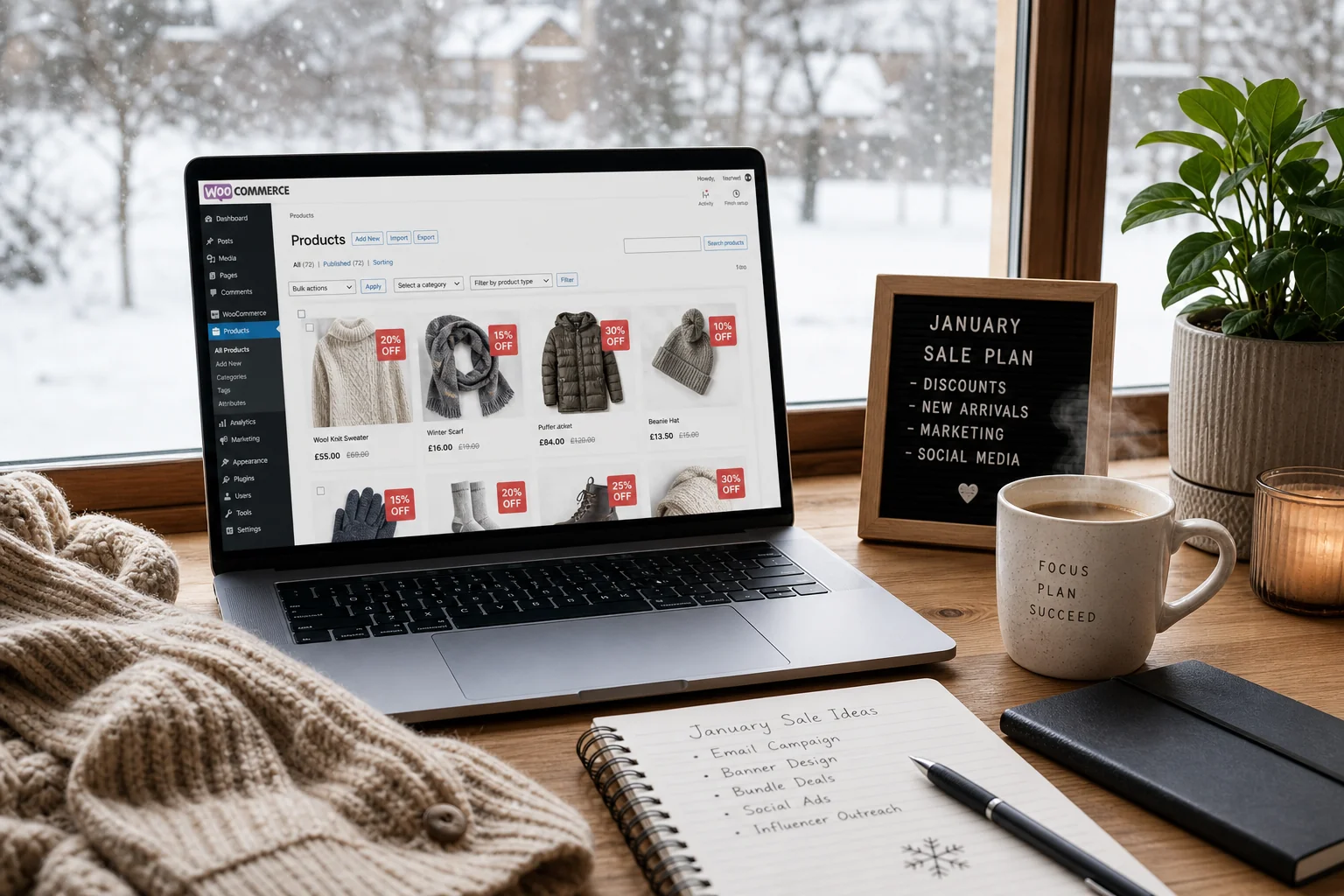
WooCommerce provides built-in tools for managing product discounts, coupon codes, and seasonal promotions. This makes it possible to run a straightforward January campaign without automatically needing a complex promotional system.
The first step is to organize the products that qualify for the sale. Create a dedicated winter clearance category or collection, confirm which items remain in stock, and check that customers can easily navigate between product pages and the relevant promotional offers.
For more advanced campaigns involving interactive rewards, additional software may be useful. However, the basic sale setup should remain reliable even when no popup or gamified experience is displayed.
Schedule Winter Sale Prices
WooCommerce allows store owners to set sale prices for individual products. Open the product editor, navigate to the pricing settings, enter the sale price, and use the scheduling option to define the promotional period.
According to the official WooCommerce product editor documentation, regular products support scheduled sale prices, while variable products require attention to the pricing of individual variations.
Before publishing, check the start and end dates, the store's time zone, and the products included in the promotion. Test how prices appear on product pages and in the cart to make sure the displayed offer matches the intended campaign.
Configure Coupons and Discount Restrictions
WooCommerce also includes built-in coupon management when coupon functionality is enabled, letting store owners create percentage or fixed-value discounts and apply relevant restrictions. Check your store's current settings for the exact location of these controls. Store owners can create percentage or fixed-value discounts and apply relevant restrictions.
The official WooCommerce coupon management guide explains options such as minimum spending requirements, product eligibility, usage limits, coupon expiration, and excluding sale items.
These settings are particularly important when combining clearance prices with additional promotional rewards. For example, if a game-based coupon should not apply to already discounted products, configure and test the restriction rather than assuming that WooCommerce will automatically prevent the combination.
Always test both eligible and ineligible shopping carts. Verify the final amount paid, how coupon discounts interact with product prices, and whether the promotion behaves correctly when it expires.
A Practical January
Sales Campaign Timeline
January promotions benefit from a clear structure because inventory, customer demand, and promotional priorities can change throughout the month. A campaign that begins with broad clearance may need to shift toward specific remaining products, customer retention, or evergreen collections as the month progresses.
Rather than committing to the same discount for four consecutive weeks, review results regularly and adjust promotions based on actual demand. This helps avoid over-discounting products that are already selling while overlooking slow-moving stock.
Week 1: Launch the Main Winter Sale
Begin with a clearly organized sale collection and communicate which products qualify. Update relevant website banners, product listings, and marketing emails so customers receive consistent information.
Monitor inventory levels and checkout performance from the beginning. A strong early response to certain products may require adjusting their visibility or removing additional incentives that are no longer necessary.
Week 2: Introduce Bundles and Relevant Product Recommendations
Use the first week's results to identify products that need additional attention. Consider pairing slower-moving items with complementary products or highlighting categories that customers have already shown interest in.
This is also a suitable period for useful buying guides and recommendations that encourage visitors to explore beyond the discounted inventory.
Week 3: Focus on Engaged Subscribers and Returning Customers
Review how existing customers and eligible email subscribers have responded to the campaign. Segment follow-up communications and consider a relevant second-purchase incentive where the commercial case supports it.
If you are testing gamified rewards or exit-intent promotions, evaluate engagement alongside actual purchases and incentive costs. Avoid expanding an offer solely because visitors enjoy interacting with it.
Week 4: Review Remaining Stock and Prepare the Transition
As January ends, assess which products still require clearance and which should return to regular promotional activity. Some items may benefit from a final targeted offer, while others may be better retained for future seasonal demand.
Prepare the transition into February by updating the website, removing expired promotions, and reviewing subscriber engagement. A successful January campaign should finish with a clearer inventory position and useful customer insights.
Measure Sales
Performance Beyond Revenue

Revenue alone doesn't show whether a winter promotion achieved its objectives. A campaign can generate substantial sales while reducing profitability if discounts, shipping subsidies, and advertising costs become too high.
The most useful metrics depend on the campaign objective. A clearance campaign should focus on inventory movement and profitability, while a subscriber engagement campaign needs to evaluate qualified leads and subsequent purchases. These outcomes should be assessed separately before reviewing their combined business impact.
For WooCommerce stores, the customer and purchase metrics used in gamification offer a useful starting point for connecting engagement with commercial results.
Key January Sales Metrics to Track
-
Inventory sell-through rate: The percentage of available inventory sold during the defined period. Use consistent inventory assumptions, particularly when new stock arrives during the campaign.
-
Revenue per visitor: Revenue divided by the number of visitors in the measured audience, helping compare performance across promotions.
-
Average order value: Revenue per completed order, useful for evaluating bundles and spending incentives.
-
Contribution profit: Revenue remaining after product costs and relevant variable expenses, including discounts and fulfillment costs.
-
Email subscriber purchase rate: The percentage of a defined subscriber group that completes a purchase during the measurement window.
-
Second purchase rate: The percentage of eligible first-time customers who return to place a second qualifying order within a specified period.
-
Coupon redemption and associated sales: The number of rewards redeemed and purchases linked to promotional codes, considered alongside their costs.
These metrics help retailers distinguish between activity and genuine commercial value. For example, a bundle promotion might increase average order value but contribute less profit if the discount is too large.
Evaluate Inventory Clearance With a Simple Example
Imagine a hypothetical online store beginning January with 300 units of a selected winter product. During the month, it sells 120 units without receiving additional inventory.
The sell-through calculation for that period is:
Sell-through rate = (Units sold ÷ Units available) × 100
(120 ÷ 300) × 100 = 40%
The store sold 40% of the available units during the measurement period. Whether this is a satisfactory result depends on the product's remaining demand, storage costs, margins, and the retailer's inventory objectives.
For a more complete assessment, compare contribution profit and remaining stock value with the expected outcomes of alternative promotional strategies.
Use Analytics to Understand Customer Behavior
WooCommerce reporting can help retailers examine product sales, customer orders, and coupon activity. Google Analytics 4 can provide additional information about website behavior and purchases when the relevant e-commerce events are correctly implemented.
Google's official GA4 e-commerce purchases documentation explains how product-level purchase data and related metrics are collected.
When comparing promotions, consider differences in traffic sources, advertising spend, inventory availability, and seasonal demand. An increase in conversions during a sale doesn't automatically establish that a specific popup, email, or incentive caused the improvement.
Where possible, use controlled tests to estimate incremental results rather than relying exclusively on before-and-after comparisons.
Common Mistakes That
Can Undermine January Promotions
One of the biggest mistakes is offering increasingly large discounts without reviewing profitability. A deeper price reduction might accelerate stock clearance, but it can also reduce the value of products that would have sold with a smaller incentive. Retailers need to evaluate each product category rather than relying on a single storewide approach.
Another common problem is poor coordination between promotions. If a store advertises a clearance price and then distributes additional coupons without checking restrictions, the combined discount may be larger than intended. Clear eligibility conditions and thorough checkout testing help prevent these issues.
Overusing promotional popups can also damage the shopping experience. A visitor who has just opened a product page should generally have an opportunity to explore the product before being interrupted. Reserve interactive offers for relevant moments and avoid repeatedly displaying the same message after dismissal.
Finally, don't overlook the customers acquired during the holidays. A retailer that focuses exclusively on clearing inventory may miss opportunities to build relationships with new subscribers and first-time buyers. Relevant follow-up communication and dependable customer service can remain valuable after the January sale ends.
Conclusion: Make January Sales Work
for Your Business Beyond Winter

The most effective January sales ideas combine thoughtful inventory management with relevant customer experiences. Targeted clearance offers, practical bundles, carefully planned incentives, and segmented email campaigns can help retailers manage seasonal stock while maintaining relationships with customers acquired during the holidays.
Rather than measuring success solely through discounted revenue, evaluate how efficiently inventory moves, whether promotions remain profitable, and how many first-time customers return. These insights can help improve future seasonal campaigns and reduce dependence on increasingly aggressive discounts.
If you want to make your post-holiday promotions more interactive, explore Funnelsio's gamified exit-intent solution. Its game-based coupon rewards can complement your WooCommerce winter sale by engaging departing visitors and creating another opportunity to turn interest into a purchase.
Questions
Answered
Common questions related to this topic.
What are january sales ideas?
January sales ideas involve strategies that online stores use to clear winter inventory and attract new customers. These can include promotional discounts, clearance popups, and targeted email marketing campaigns. For instance, offering a New Year sale can entice shoppers looking for deals after the holiday season.
How can I implement winter sales strategies?
To implement winter sales strategies, start by identifying excess stock and creating compelling offers around those items. Use marketing tools like clearance popups on your website to highlight these deals. This approach not only helps in clearing inventory but also engages customers with attractive discounts.
Why are clearance popups effective?
Clearance popups are effective because they grab visitors' attention while they browse your site, promoting limited-time offers on winter stock. This creates a sense of urgency, encouraging immediate purchases. For example, a popup showing a countdown timer can motivate shoppers to buy before the sale ends.
When should I launch a New Year sale?
Launching a New Year sale right after the holiday season is ideal, as consumers are still in the buying mindset. Aim to start your campaigns in the first week of January to capture interest from shoppers who are looking for deals and discounts on winter merchandise.
Can email marketing boost january sales?
Yes, email marketing can significantly boost january sales by reaching out to existing and potential customers with tailored promotions. By segmenting your email list, you can send personalized offers that resonate with different customer groups, enhancing engagement and increasing conversion rates.
Should I offer discounts during post-holiday sales?
Offering discounts during post-holiday sales is a smart strategy to retain customer interest and encourage repeat purchases. Many consumers expect sales during this period, making it an opportune time to introduce promotions on leftover winter stock or new arrivals.
Ready To GrowThis Into Results?
Discover practical January sales strategies for online stores, from winter clearance offers and product bundles to targeted emails and gamified exit-intent rewards. Learn how to sell seasonal inventory, retain holiday subscribers, and measure campaign profitability.
Prefer to reach out directly? We'll get back to you as soon as possible.
Contact MASS DATA Today